




Gurukul Lutheran Theological College & Research Institute, Kilpauk, Chennai
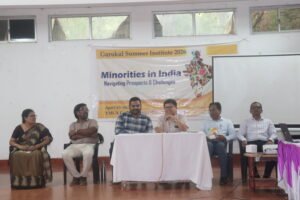
Gurukul Summer Institute – 2026
YMCA Camp, Yelagiri Hills, Tamil Nadu
April 27-30, 2026.
MINORITIES IN INDIA: NAVIGATING PROSPECTS AND CHALLENGES
The concept of “minority” has been interpreted and debated diversely in different fields of study. In common parlance, the term minority refers to a relatively small community or group within a country that possesses distinct ethnic, religious, cultural, or linguistic traditions. India, often celebrated as a land of diversity, is characterized by a rich mosaic of cultures, languages, religions, and ethnic identities. Within this pluralistic framework, minorities in India represent a broad spectrum of communities, including religious, caste, linguistic, sexual, and gender minorities, each possessing distinct identities and often confronting varying forms of social marginalization. Although the term “minority” is not explicitly defined in the Constitution of India, several constitutional provisions safeguard minority rights, including Articles 14, 15 (1), 16 (1), 25, 26, 29, and 30 (1–2), which collectively ensure equality before the law, protection from discrimination, freedom of religion, and the right of minorities to preserve their culture and establish and administer educational institutions.1 The National Commission for Minorities, established under the National Commission for Minorities Act, 1992, is mandated to safeguard the interests of minority communities and monitor the implementation of constitutional protections.2 Additionally, linguistic minorities receive protection under Articles 350A and 350B, which provide for mother-tongue instruction and the appointment of a Special Officer for linguistic minorities.3 In contemporary discourse, the concept of minority has broadened to include groups such as women, children, persons with disabilities, and sexual minorities, whose rights and welfare have increasingly become central to legal, social, and political debates in India. Despite their diversity, India’s minorities share common challenges, including discrimination, marginalization, and the struggle for identity and representation. The rise of majoritarianism in recent years has further exacerbated these issues, leading to increased polarization and communal tensions. The experiences of these communities highlight the complexities of living in a pluralistic society. While India’s constitution guarantees equality and freedom for all the minorities, the ground reality often falls short of these ideals. Atrocities against minorities in India remain a significant concern in its social and political landscape. Minority communities – particularly religious, caste, ethnic, and other marginalized groups – often face discrimination, hate crimes, communal violence, and social exclusion. Such atrocities may include attacks on places of worship, mob violence, forced displacement, restrictions on religious practices, and systemic inequalities in access to education, employment, and justice. These incidents not only threaten the safety and dignity of minority communities but also undermine the democratic and pluralistic ethos envisioned in the Constitution of India.
Addressing these challenges requires a multi-faceted approach, including legal reforms, affirmative action, and efforts to promote interfaith dialogue and understanding. Minorities in India are not merely passive recipients of societal forces but active agents of change, contributing to the nation’s progress in innumerable ways. Their stories of resilience, adaptation, and contribution underscore the importance of preserving India’s pluralistic ethos and ensuring that diversity remains a source of strength rather than division. Hence it is explicit that India is a multi-religious, multi-cultural, multi-lingual and multi-racial country interwoven into an innate unity by the common thread of national integration and communal harmony. Despite its social pluralism which is fortified by the unique Constitutional concept of secularism, and constitutionally mandated protection and promotion of rights of all minority communities, still the minorities of India face discrimination and violence which is a stark reminder how the nation’s pluralistic ethos is at danger. Thus, minority communities in India – particularly the theological fraternity – have a significant prophetic role to play in addressing the various forms of discrimination experienced by marginalized groups. Recognizing this urgent responsibility, the Gurukul Summer Institute 2026 has chosen the theme “Minorities in India: Navigating Prospects and Challenges” as the focus of its theological discourse. As a theological institution committed to academic rigor, social justice, and ecumenical vision, this Gurukul Summer Institute-2026 aims to advance critical scholarly interrogation from multiple disciplinary perspectives. By fostering scholarly engagement with both challenges and prospects, the seminar aims to generate meaningful dialogue relevant to contemporary Indian realities while contributing to wider academic and societal conversations. Given the interdisciplinary nature of the theme, different departments can engage with this topic meaningfully from their respective and academic standpoints. The following are the perspectival proposals suggested for each department, intended as preliminary frameworks that may be further explored and critically problematized in addressing the issues concerning minority communities in India, particularly their prospects and challenges in the contemporary Indian context:
Biblical Studies: Exploration and examination of how scriptural traditions portray vulnerable groups can be done in order to offer ethical paradigms of justice, inclusion, and communal responsibility. Hebrew Bible/Old Testament – 3 Papers Explorations on minorities in the Hebrew Bible may be undertaken through exegetical studies of the legal codes of the Torah/Pentateuch, particularly in relation to their provisions for safeguarding the rights and dignity of vulnerable and marginalized groups. In addition, prophetic texts may be examined for their insights into the plight of the oppressed, while the Wisdom literature can be investigated to discern its ethical perspectives on justice, compassion, and the treatment of minorities. New Testament – 3 Papers Studies in the area of New Testament may explore the concern for marginalized and minority groups as reflected in the Synoptic Gospels, the Pauline corpus, and the General Epistles. Such investigations can be undertaken within the socio-political context of the Greco-Roman world,drawing contextual and theological implications for addressing the realities of minorities in the contemporary Indian context.
Christian Theology, Ethics and Women’s Studies – 5 Papers (3 CT; 1 Ethics; 1 WS) Exploration on doctrinal resources to defend minority rights, critique structures of power, and articulate visions of hospitality and human flourishing. Critically engagement in the concerns of minorities in India may be undertaken through contextual readings and interpretive frameworks. Such studies may address not only ethnic minorities and communities at the social margins, including subaltern groups, but also sexual minorities and the challenges they encounter. Furthermore, scholarly investigations may examine the experiences of Indian women in diverse socio-cultural contexts, particularly in relation to their positioning and encounters as minorities within various structures of power and society. ▪
History of Christianity and Mission – 3 Papers (1 HC; 2 Miss.) Exploration of how minority communities have negotiated identity, mission, and sociopolitical pressures across different periods of Christian history. Papers may also focus on the contributions of Christians, as a minority community, to nation-building in India. In addition, studies may explore instances of atrocities against minorities in Indian history that remain undocumented or insufficiently examined, as well as the historical development of minority movements. Furthermore, research may investigate the mission dimensions and the missiological challenges encountered within a pluralistic context such as India. ▪
Religion (Hinduism & Islam) – 3 Papers (2 Hinduism; 1 Islam) Revisiting the history of Hinduism and its religious texts in order to highlight concepts of tolerance and the acceptance of the “other,” particularly in the context of the contemporary discourse on Hindutva and the idea of Hindu Rashtra that is often critiqued for overlooking minority communities, may serve as a significant area of exploration. In addition, scholarly inquiry may examine Islamic teachings alongside the socio-political challenges faced by the Muslim minority in present-day India. Also analyse the contemporary interreligious dynamics, majoritarian narratives, and the shifting identities of religious minorities. ▪
Christian Ministry and Communication – 4 Papers (2 CM; 2 Com.) Area can address the role of the Church in advocating justice, promoting interreligious harmony, and providing pastoral care to communities experiencing discrimination and exclusion. Moreover, from the perspective of Communication, papers can examine how mainstream and digital media frame issues concerning religious, linguistic, caste, and sexual minorities, particularly during periods of communal tension or political mobilization. Papers can be done from Tribal and Dalit perspectives, which may highlight how various forms of marginality intersect in lived experiences. Meanwhile, Christian Ministry can address pastoral responses through ministerial engagement, preaching, pastoral care, and counselling. —
Editorial Team GSI 2026